Why Are We Still Managing Major Programmes by Looking Backwards?
By Karl Connor 3 min read
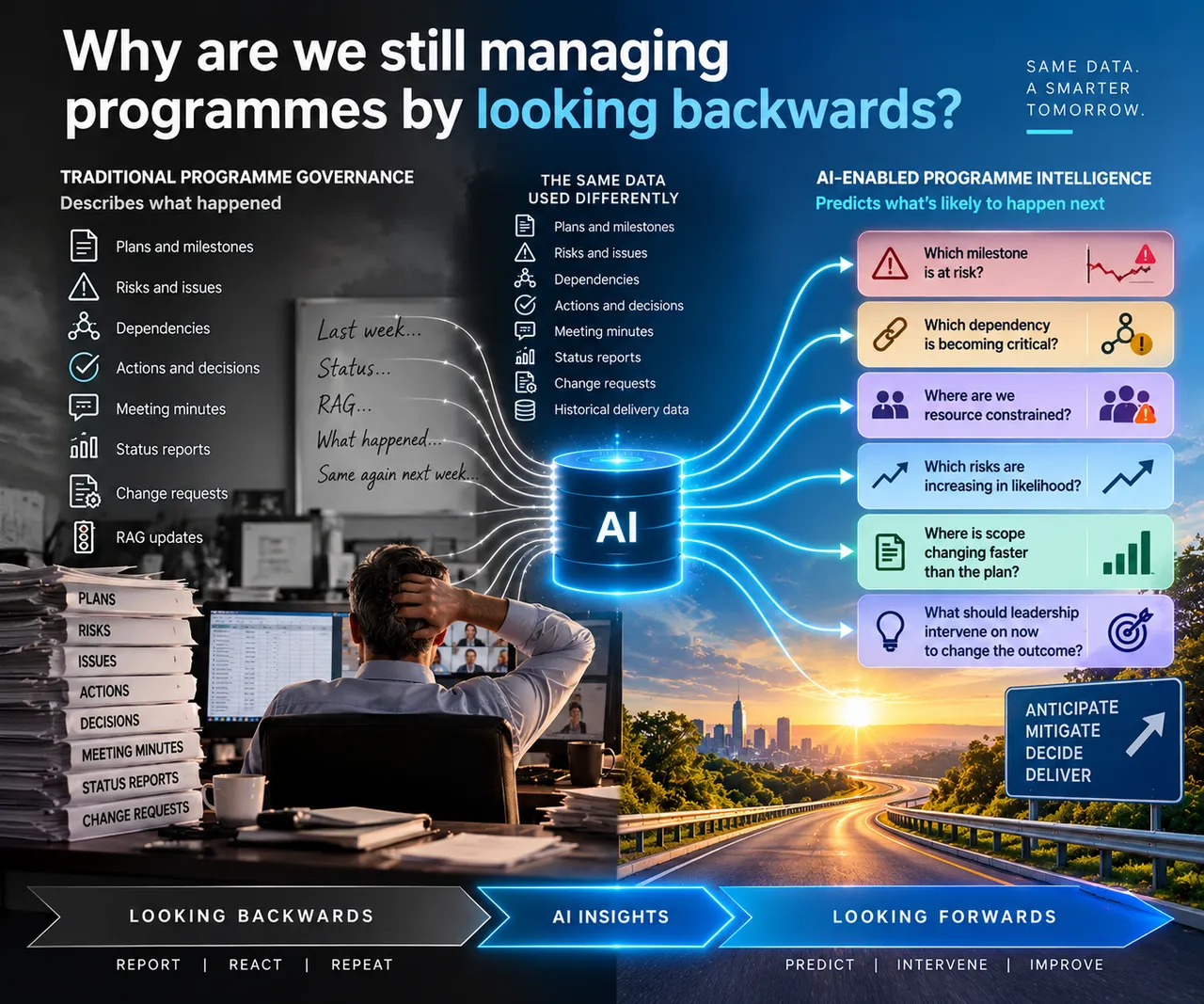
Most programme governance is very good at explaining what has already happened. Teams update plans, chase actions, refresh RAID logs, debate RAG status and assemble reporting packs. Leadership then reviews the position at a point in time.
That matters. But for a major transformation, it is not enough.
The more valuable question is: what is likely to happen next, and what can we do about it now?
The limits of the weekly status cycle
A programme can be Green while underlying signals suggest increasing pressure. A supplier dependency is unresolved. A decision has been deferred repeatedly. Several critical-path activities depend on a team whose capacity is already constrained. Individually, each may be explained away; together, they tell a different story.
A status pack can miss those relationships when information is maintained in separate tools and manually summarised.
What predictive governance could look like
A connected delivery environment could analyse plans, milestones, dependencies, actions, decisions, resources, risks, issues and changes to highlight patterns that warrant investigation:
- Which milestone is becoming vulnerable, even though it has not slipped yet?
- Which dependency is moving towards the critical path?
- Which overdue decisions are constraining delivery options?
- Where is scope changing faster than the baseline can absorb?
- Which risks are becoming more likely based on current evidence?
The goal is not to pretend that AI can predict programme outcomes with certainty. It is to surface evidence, explain why a warning has been raised and help leaders test the assumptions behind a confident status.
Governance should support intervention
The real measure of governance is not the quality of the slide deck. It is whether leaders receive timely, credible information that helps them change the outcome.
Programme directors and PMOs remain accountable for judgement, escalation and decision-making. AI should make that judgement better informed, not replace it.
That means traceable data, explicit confidence levels, ownership of actions and an ability to challenge the model when it gets something wrong.
From reporting to intelligence
Instead of spending most of the cycle assembling a picture of the past, delivery teams could spend more time examining the future and acting on what they find.
Report → React → Repeat is a familiar model.
Anticipate → Intervene → Improve is a better ambition.
The question I would put to any steering committee is simple: what evidence supports our confidence that this programme will deliver?
From insight to action
These are some of the challenges that informed Blue Squircle, an independent enterprise delivery intelligence platform. Blue Squircle helps teams manage delivery, make informed decisions and reuse organisational knowledge across programmes, projects, product development and sales. Explore the approach on the Blue Squircle overview.
Explore the platformThe views expressed are my own. Examples are illustrative and do not describe confidential client programmes. No employer endorsement is implied.
Karl Connor
Programme & Transformation Director. PRINCE2, SAFe Agile. Founder of Blue Squircle.